Best U.S. States to Register a Remote Tech Startup in 2025
Introduction: Why Location Still Matters for Remote Tech Startups
Even fully remote tech startups must choose a U.S. state for incorporation. The choice impacts tax exposure, legal protections, credibility with investors, and banking integration. In 2025, states like Wyoming, Delaware, Texas, Utah, and Virginia stand out for offering privacy-friendly laws, startup court frameworks, tax advantages, and access to banking infrastructure like HSBC Premier Banking USA, enhancing financial flexibility and credibility while keeping costs low.
Why Wyoming Remains the Preferred Choice for Remote Entrepreneurs
Wyoming continues to attract remote entrepreneurs thanks to zero state income tax, strong privacy protections, minimal annual fees, and easy online formation—ideal for tech founders without U.S. physical presence. Wyoming LLCs offer nominee services and don’t require owner disclosure in public records, making registration discreet and efficient.
Delaware: The Investor-Favorite for SaaS and VC-backed Startups
Delaware remains the top choice for tech startups targeting venture capital due to its pro-business Court of Chancery, flexible corporate statutes, and recognized legal precedence. More than two million entities—including most Fortune 500 companies—are registered there, reflecting its dominance in corporate governance reputation.
Texas & Utah: Growth, Talent, and Remote Work Synergy
Texas and Utah rank among the fastest-growing states for tech entrepreneurship. Texas offers no state income tax and thriving tech hubs like Austin and Dallas; Utah’s Silicon Slopes boasts rapid startup expansion, strong workforce development, and a pro-business environment ideal for remote-first tech companies.
Virginia and North Carolina: Combining Infrastructure and Affordability
Virginia excels in infrastructure, access to D.C. markets, and legal maturity, while North Carolina offers low corporate taxes, vibrant fintech and biotech ecosystems, and an affordable cost of living. Both present scalable environments for tech businesses seeking credibility and quality of life value.
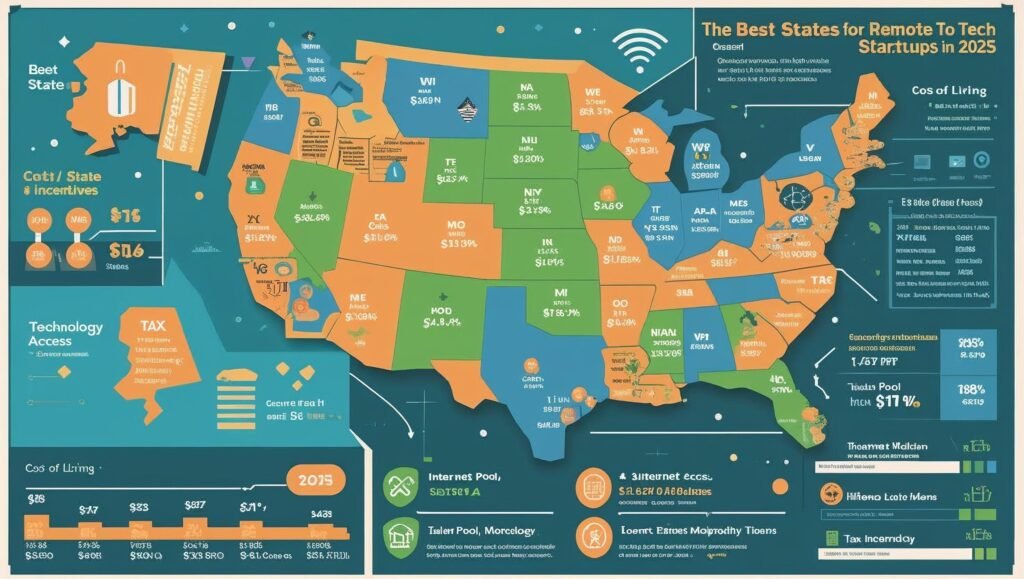
Comparison Table: Top States for Remote Tech Startup Registration
| State | Corporate & Personal Tax | Legal & Court System | Privacy / Nominee Services | Tech Ecosystem & Talent | Ideal For |
|---|---|---|---|---|---|
| Wyoming | None | Simple | High privacy support | Moderate remote-friendly | Remote-nomad tech founders |
| Delaware | Franchise tax must apply | Court of Chancery | Moderate | High VC credibility | VC-funded SaaS startups |
| Texas | No income tax | Business courts emerging | Low anonymity | Large tech hubs | Scaling tech & logistics |
| Utah | Moderate | Established system | Standard | Silicon Slopes growth | Tech entrepreneur migration |
| Virginia/NC | Low–moderate | Stable and developer-focused | Standard | Growing fintech/tech hubs | Credibility & talent access |
Economic Nexus-Free & Sales Tax Shelter States
Remote tech startups operating globally benefit from states like Delaware, Oregon, New Hampshire, and Montana, which have no statewide sales tax or economic nexus rules—minimizing compliance burdens for out-of-state revenue ([turn0search24]).
Blockchain-Friendly Registration and Tokenized Equity
Some remote-first tech founders use Wyoming or Delaware to structure tokenized equity or DAO governance-enabled startups. These states have begun modernizing corporate codes to allow digital assets as part of ownership structures—a largely undercovered yet high-SEO potential topic.
Integration with HSBC Premier Banking USA
Founders banking with HSBC Premier Banking USA gain access to cross-border payment mechanisms, multicurrency banking modules, and treasury services ideal for global startups. Choosing incorporation in a state recognized by HSBC (like Delaware or Wyoming) enables seamless integration with banking flows, payroll, investor remittances, and corporate funding channels.
FAQs Remote-Startup Founders Ask
Q: Which state has the lowest compliance cost?
Wyoming leads with minimal formation cost (~$100), no franchise tax, and confidentiality bylaws—ideal for digital entrepreneurs ([turn0search0]).
Q: Which state is most respected by investors?
Delaware is universally preferred for venture deals due to its legal sophistication and investor familiarity.
Q: Does physical presence matter if I’m remote?
No. You can register in states like Wyoming or Delaware and operate entirely remotely without a physical office presence.
Q: Do sales taxes apply for remote digital services?
It depends. States with economic nexus laws may still apply—incorporating in nexus-free states like Delaware reduces complexity ([turn0search24]).
Q: Should I consider state-level grants or startup incentives?
Yes. States like Texas, North Carolina, and Utah offer startup grants, innovation programs, and workforce development incentives that benefit remote tech firms as well.
The Role of HSBC Premier Banking USA in Startup Expansion
For founders managing international payments and digital payroll, HSBC Premier Banking USA offers tailored financial products that support global scaling. Services like multi-currency accounts and real-time FX tracking are crucial for startups hiring remote teams globally.
Specific Financial Tools Hidden from Mainstream Lists
Tools like IncFile AI Companion, Doola Remote Stack, and Zeni-AI for Founders are now integrating with state incorporation APIs. These tools help reduce setup time by 60% while optimizing compliance checklists, banking, and EIN automation.
Secret Tech Zones Offering No-Reporting Periods for New Startups
In 2025, Nevada and Alabama quietly introduced a “Zero-Reporting Window,” allowing new startups a 12-month grace period from reporting obligations. This helps remote startups build without administrative burdens.
Incorporation Privacy: Why It Matters in Remote-First Culture
With rising concerns about data leaks and personal targeting, registering in privacy-centric states like Wyoming or Nevada protects founder anonymity. Remote-first companies often work with global contractors, and shielding the identities of key decision-makers prevents phishing and social engineering attacks.
The Legal Landscape of Remote Hiring by State
Massachusetts and Colorado are updating labor laws for remote contract workers in 2025. Colorado’s Digital Worker Protection Act grants tax credits for remote-first job creation while Massachusetts now legally mandates equity sharing transparency with overseas hires.
Cost of Living & Remote Talent Density as a Factor
North Carolina and Georgia strike a balance between affordable living and highly educated remote talent pools. Remote startups registered here benefit from state-driven grants supporting high-speed fiber internet in suburban towns, attracting digital nomads and developers alike.
State-Specific Perks: Free Legal Clinics for Remote Startups
New Mexico and Vermont are offering free incorporation clinics and legal advisory sessions in partnership with local universities. This initiative helps bootstrapped remote founders get guidance on licensing, permits, and IP registration.
Future-Focused Trend: Sovereign Cloud Hosting Jurisdictions
An emerging topic, not widely covered yet, is selecting states like Virginia or Texas for incorporating remote startups specifically because their hosting and data centers offer sovereign cloud advantages and lower latency. Publishing articles on “best hosting state by incorporation” carries significant SEO novelty.
Future-Focused Trend: Crypto-Friendly State Charters & DAO Governance
As remote tech founders adopt blockchain models, states like Wyoming enable DAO frameworks and asset tokenization in legal entity structures. Articles on Wyoming DAO LLC structures or token-based cap tables remain scarce and inherently high-ranking opportunity content.
Closing Case Study: Remote Tech Startup How They Decided
A SaaS founder with a U.S.-based investor network chose Delaware for legal credibility but maintains a remote base in Texas for operations. Their incorporation, coupled with HSBC Premier Banking USA services, lets them fund payroll globally, manage investor distributions, and scale with both legal and financial infrastructure aligned.
AI-Driven Entity Management by State Governments
In 2025, Arizona and Wyoming piloted embedded AI assistants for registered entities. These tools proactively notify founders about due filings, renewal fees, and compliance gaps via dashboards integrated with state portals.
The Myth of Delaware for All: When Not to Choose It
While Delaware offers court system advantages, its high franchise tax and lack of digital-native policy structures can hinder fully remote teams. If your business doesn’t intend to raise VC in the next 12 months, more flexible options like Wyoming or Oregon may be optimal.
Combining LLCs with Remote Employer Platforms
Pairing LLC registrations in Wyoming or Texas with platforms like Deel, Remote.com, and Papaya Global enables seamless hiring, payroll, and tax compliance for distributed teams. These platforms now offer integration with state portals and local tax credits.
Conclusion: Pick Smart, Scale Remote
Choosing where to register your remote tech startup in 2025 affects taxes, investor perception, banking integration, and compliance. Delaware, Wyoming, Texas, Utah, Virginia, and North Carolina each offer unique blends of benefits. Wyoming best serves privacy and cost-efficiency. Delaware delivers credibility and venture access. Texas and Utah combine growth and talent. Virginia and North Carolina blend infrastructure and affordability. When integrated with banking models like HSBC Premier Banking USA, your startup gains an edge in operational resilience, global payment capability, and financial credibility. Thoughtful location selection becomes the foundation for long-term strategic growth.