Voice-Activated Loan Applications via Business CRM Dashboards (2025 Guide)
Bank lending moved from paper to portals and then to mobile forms, but the next leap is happening inside the very screens lenders already live in. In 2025, relationship managers and SMB owners are initiating and completing loan applications with their voices directly inside business CRM dashboards. Instead of tabbing through dozens of fields, a borrower or banker speaks naturally while an embedded voice layer captures intent, fills data, verifies identity, generates disclosures, and pushes an application through decisioning. The result is less abandonment, shorter time to yes, and a more inclusive experience for founders who are busy, on the go, or managing in a second language. The shift is not merely cosmetic because a voice layer forces cleaner process design, stronger identity proofing, and auditable transcripts that help underwriting and compliance work with the same source of truth.
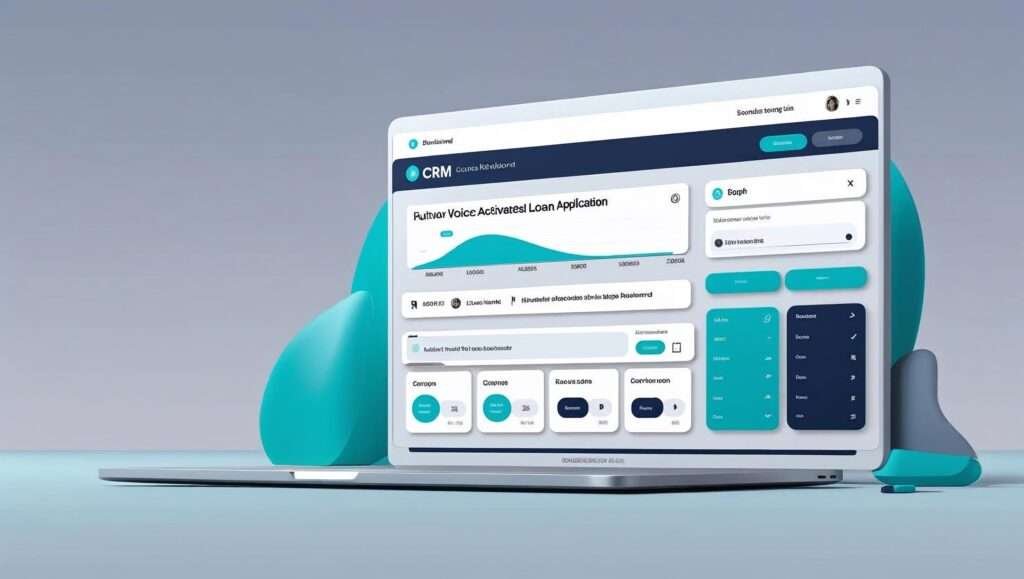
Voice inside CRM matters because the CRM already holds account hierarchies, opportunity stages, KYC snapshots, and servicing history. Embedding a speech interface there allows every utterance to be grounded in first-party context. When a borrower says they want to refinance equipment or expand inventory, the widget can fetch existing collateral data, pre-fill legal names, auto-suggest the right product, and request only the missing evidence. Where web forms treat every applicant as a stranger, a CRM-native voice assistant recognizes the relationship, respects privacy permissions, and narrows the questions. This is how banks and fintech lenders move from generic forms to conversational underwriting that feels human yet is far more disciplined than free-form calls.
The technology stack has matured enough to make this practical. Automatic speech recognition now runs with domain-adapted vocabularies that understand acronyms like UCC, DSCR, ACH, and NAICS codes. Large language models route intent across flows such as prequalification, line increases, SBA options, or document follow-ups. Real-time redaction strips sensitive data like social security numbers from raw audio while keeping tokenized placeholders for audit. The same console can surface explainable suggestions to the banker who is guiding the customer, showing which answers triggered additional verifications and which risk controls passed silently. Conversational state survives between steps so the applicant can pause, sign documents later, or resume on another device without re-starting the application.
Voice drives measurable economics when it removes friction at the two drop-off cliffs that ruin loan funnels. The first cliff is discovery, when borrowers know they need funds but cannot map bank jargon to their problem. A natural language prompt such as “I need a seasonal cash boost for thirty days” is simpler than picking between secured term loans, evergreen lines, and merchant cash advances. The second cliff is documentation, where borrowers give up when asked to upload or reconcile statements. A voice layer in the CRM can issue precise, conversational requests, confirm what the bank already has, and trigger secure links for anything missing. Every minute saved at these cliffs is a direct lift in funded volume without loosening credit risk.
Voice also broadens accessibility. Many small business owners multitask at job sites, in kitchens, or on shop floors, and typing on a cramped screen is not realistic. A speak-to-apply flow reduces the barriers for applicants with visual impairments or dexterity challenges and helps non-native English speakers by slowing the pace and confirming understanding with paraphrased summaries. Compliance teams often worry about the subjectivity of voice, but the paradox is that recorded, time-stamped, redacted audio plus generated transcripts create a stronger, more reviewable record than free-form email threads or handwritten notes. When dispute or audit arrives, the bank can replay the moment a consent was given or a rate was quoted, and the CRM can tie that clip to the exact version of disclosures that were displayed.
There is a cultural change for bankers who fear that automation will make them less central to the relationship. In practice the opposite occurs. The banker becomes a conductor who orchestrates the conversation, sees what the voice model extracted, and corrects edge cases. Because the CRM routes next best actions in real time, the banker spends less time hunting for template emails or chasing paperwork and more time diagnosing the real business problem. Voice removes the dead air between steps and replaces it with clear, confirmable progress that both sides can see.
Why voice inside CRMs wins over stand-alone bots
There are many voice demos that live on a website or a smart speaker, yet they lack bank-grade context. A CRM-embedded assistant knows which entity is on the line, which products they already own, and what policy rules apply to their segment. If a Premier client, for example, has set currency preferences or collateral covenants, the assistant plays within those boundaries. When voice lives outside the CRM, every step requires new authentication and field mapping, which introduces delay and risk. Inside the CRM, there is a single canonical record that underwriting, risk, and servicing trust, and the conversational layer simply becomes a new input method that populates the same schema.
The CRM surface also simplifies change management. Risk teams can version prompts, capture model outputs, and compare performance across cohorts without shipping new mobile app releases. When regulators ask for evidence of consistent treatment, product teams can show that every applicant received the same scripted disclosures with the same acceptance checks, even though the interaction felt fluid. By using the CRM’s permissioning and logging, voice sessions inherit rights and retention policies rather than bolting on a separate store of sensitive audio that will become a discovery hazard later.
Architecture for bank-grade voice loan applications
A production-ready layout starts at the edge with on-device or browser-based speech capture that encrypts at source. An industry vocabulary pack improves recognition for legal names, addresses, routing numbers, and financial jargon. The stream flows to an ASR engine that outputs time-coded text and confidence scores. A redaction service masks sensitive tokens before anything persists, substituting hashed placeholders so downstream systems can reference the data without exposing it. A policy-aware orchestration layer maps utterances to loan intents, calls the CRM for prefill, and renders dynamic forms that change based on answers. A document agent binds voice answers to required evidence and triggers requests to accounting, payroll, and tax systems so the applicant does not upload what the bank can fetch securely.
On the decisioning side, the voice transcript feeds a feature pipeline that labels revenue stability, seasonality hints, and stated purpose. These features complement file-based data such as bank statements and card sales. A credit policy engine then computes eligibility while the dialog continues, and the assistant explains tradeoffs between term, rate, and collateral in plain language. The CRM renders a summary before submission that the applicant can accept verbally and then confirm with an e-signature. The entire flow generates a compliance packet with audio clips, transcripts, redaction logs, and disclosure versions tied to a single opportunity record.
Identity, consent, and compliant conversational records
Voice introduces fresh opportunities for strong identity without making the experience brittle. Passive voice biometrics can verify that the same person is speaking across the session, while liveness checks deter playback attacks by asking for short randomized phrases. Because financial data moves through the CRM, consent becomes first-class. Before fetching payroll or tax records, the assistant explains what is being accessed, for what purpose, and for how long, and the transcript stores an affirmative acknowledgment. Consent is not a checkbox hidden at the bottom of a form but a clear moment the bank can prove later.
Compliance extends to marketing promises and suitability. The assistant never improvises rates or guarantees and instead reads from an approved catalog of offers tied to the applicant’s segment. Where the conversation drifts into territory that requires standardized language, the model switches to locked prompts and then returns to free conversation. This balance preserves natural flow without letting hallucination creep in. When a human banker supervises, the CRM shows which sentences were policy-locked and which were generative so they can intervene before submission. Auditors gain confidence because every claim in the dialog maps to an internal reference.
Hidden capabilities lenders are quietly deploying
The first quiet capability is domain-aware error recovery. When a borrower misspeaks an employer identification number or confuses gross with net revenue, the assistant does not scold or restart the form. It asks a clarifying question, repeats what it heard, and surfaces the field for quick correction. The second capability is real-time document narration. When an applicant views a truth-in-lending disclosure, the assistant can summarize key points and explain how prepayment penalties or balloon clauses work. The narration is not a legal replacement but an accessibility layer that helps comprehension and reduces complaints.
A third capability that does not get marketing airtime is multilingual co-authoring. A borrower can answer in Spanish while the supervising banker sees English in the CRM, and the assistant keeps both transcripts aligned for audit. Terminology is localized so the applicant hears “línea de crédito” when appropriate instead of literal translations that confuse. The fourth capability is acoustic fraud resistance. The system analyzes spectral signatures to detect synthetic voices and prompts for secondary verification if confidence drops. Together these quiet capabilities make voice feel both friendly and bank-grade.
Designing inclusive, multilingual flows without confusion
Inclusion is not only language but pacing and memory. The assistant should chunk the application into meaningful sections and recap progress after each section so applicants know what remains. It should offer to pause and send a secure link that resumes at the exact point where they left. For multilingual flows, the assistant asks which language to use for disclosures because legalese may need to remain in English to match forms while explanations can be spoken in the applicant’s language. The assistant should also adapt to cultural norms around formality, addressing the applicant by their preferred name and avoiding idioms that fail across dialects.
A well-designed assistant anticipates cognitive load. It never requests a figure without context and always explains why a number matters for underwriting. When asking for payroll data, it says that lenders use the information to judge debt capacity and that connecting the payroll system saves time and reduces errors. Summaries restate what the bank will do next so applicants are not left wondering if they completed the task. This tone of respectful clarity wins trust and lowers the chance of abandonment.
Decisioning alignment and credit risk transparency
Credit risk teams care about reproducibility. Voice cannot be a black box where underwriters later guess why a decision turned out as it did. The transcript should mark each factor that influenced eligibility, with pointers to the data sources and the policy rule that fired. If the applicant’s lease length or seasonality pattern triggered a lower limit, the assistant explains that tradeoff and suggests ways to improve eligibility, such as linking point-of-sale data or adding collateral. Transparency reduces friction because the applicant understands what the bank needs and stops playing guessing games.
Risk leaders also want to protect against bias. Voice can help by standardizing prompts and removing cues that lead bankers to make inconsistent requests. The model keeps the question order loyal to policy rather than letting personality drive the flow. When exceptions occur, the CRM asks for written rationale. Because voice makes it easy to record context, underwriters can review whether an exception was warranted and train policy to handle similar cases better next time. Seen this way, voice is not a gimmick but a calibration tool for risk discipline.
Data security from microphone to data warehouse
Security begins at capture with strong encryption and minimal retention. Raw audio need not live forever. Once the transcript is produced and redacted, the original stream can be purged under a strict schedule, while a hashed fingerprint proves integrity later. Sensitive tokens are vaulted and only rehydrated when absolutely necessary, such as during funding or account linking. Role-based access in the CRM ensures that only authorized staff can replay clips, and even then, redaction masks the most sensitive segments while preserving evidentiary value.
Downstream, data pipelines segment personally identifiable information from feature engineering stores. Analytics teams work on anonymized aggregates and do not see verbatim transcripts. When training the language model that powers prompts, the system uses differential privacy so the patterns of a single borrower cannot be reverse-engineered. Vendors are held to contractual standards that mirror the bank’s controls, with periodic audits and the right to inspect. A voice program that treats privacy as a product feature will withstand regulatory and customer scrutiny.
Comparison Table: Voice-in-CRM vs Traditional Loan Portals
| Dimension | Voice-Activated in CRM Dashboards | Traditional Web/Mobile Portals |
|---|---|---|
| Application speed | Conversational capture with context and prefill; fewer fields visible at once | Manual typing across long, static forms with repeated data |
| Abandonment rate | Lower due to guided prompts, summaries, and on-the-spot clarifications | Higher when applicants hit unknown jargon or upload hurdles |
| Identity and consent | Built-in audio consent, passive voice biometrics, liveness, and transcript evidence | Checkbox consent and separate KBA flows that feel disjointed |
| Compliance auditability | Time-coded audio, redaction logs, disclosure versions tied to CRM opportunity | Web event logs and PDFs without conversational context |
| Multilingual support | Real-time translation with parallel transcripts for audit and banker view | Static language toggles with limited comprehension support |
| Risk explainability | Inline rationales mapped to policy rules and data pointers in transcript | Outcome-only explanations that arrive after submission |
| Integration effort | Single CRM widget drawing on existing data and permissions | Multiple micro-apps stitched to core systems with custom SSO |
How HSBC Premier Banking USA-style integrations fit
Banks that serve globally active SMBs and affluent founders need voice to cooperate with multi-currency cash management and trade finance. An integration pattern similar to what a Premier-tier platform offers can let the assistant quote funding in the applicant’s base currency, explain how FX impacts repayment, and auto-create a foreign currency account when relevant. When the applicant mentions cross-border suppliers, the assistant can propose a trade loan rather than a generic term loan, and the CRM connects the dots by fetching existing KYC and sanctions checks. The voice layer does not replace banker judgment; it augments it by making complex multi-product proposals comprehensible in a few sentences.
Another valuable touchpoint is post-funding servicing. The same voice widget that captured the application can later take instructions to draw on a line, request a payoff, or update beneficiaries, and the CRM logs the commands with the same level of audit. Premier-style customers expect white-glove service, and voice provides that without sacrificing control. Because the CRM knows entitlements, the assistant will refuse actions outside mandate and route approvals instead of improvising. This carefully fenced power is what turns delight into durable trust.
Implementation roadmap for banks, fintechs, and CRMs
A sensible start is a narrow, high-volume use case such as prequalification for existing customers. This keeps identity simple and lets teams tune prompts. From there expand into full applications for unsecured working capital, then equipment or inventory loans that require document orchestration. Each expansion comes with new domain vocabularies and policy snippets that the assistant can speak clearly. Governance boards should approve prompt versions the same way they approve marketing copy, and every model change should produce a diff and a rollback plan.
CRMs can productize the voice shell so institutions configure rather than build. Admins pick which fields are speakable, which require visual confirmation, and which phrases count as valid consent. They set retention time for audio and pick which redaction categories to enforce. Over time, analytics will show which questions cause friction, and product teams can rephrase or move those to later in the conversation. Training bankers matters because their comfort with the tool will determine adoption. They should learn to glance at live transcription, correct gently, and use summaries as a coaching tool rather than bulldozing the applicant with jargon.
FAQ
How accurate is voice for financial data capture in 2025.
Accuracy depends on domain tuning and redaction strategy, but with a strong vocabulary pack and confirmation prompts, numerical fields and entity names reach production-grade reliability. The assistant repeats back sensitive items and asks for confirmation, which both improves accuracy and produces cleaner audit records than manual typing.
Does voice increase risk of social engineering and fraud.
A naive system can be tricked, which is why liveness, passive biometrics, device reputation, and session risk scores are mandatory. The CRM already knows expected devices and locations for a customer, and the assistant can escalate to human verification when those signals go sideways. The audio record also deters frivolous disputes because the bank can demonstrate that the right person authorized a step.
Will regulators accept voice consent for loan applications.
Regulatory acceptance hinges on clarity, disclosure control, and retention. When consent moments are scripted, redacted, stored with time codes, and tied to the exact disclosure version that was displayed, reviewers appreciate that voice provides richer evidence than a checkbox. Institutions still align with local e-signature and telemarketing rules, but nothing about voice is inherently non-compliant when designed correctly.
Can small lenders or community banks adopt this without massive budgets.
Smaller lenders can start with a hosted widget in their CRM, using off-the-shelf ASR and redaction, then grow into deeper integrations. Because most of the power comes from the orchestration and the policy scripts, small teams can get high impact by focusing on a few great flows rather than trying to automate every product on day one.
What happens when the applicant mixes languages or goes off topic.
The assistant handles code-switching by tracking language at the utterance level and translating for the banker when needed. When the applicant strays into topics the bank cannot discuss freely, the assistant steers back with approved language and offers to schedule a specialist. Guardrails keep the conversation safe without feeling robotic.
How does this improve funded volume without loosening credit.
Funded volume rises because fewer people abandon the application and because the assistant captures better data the first time. Underwriters get a cleaner file, with narrative context that explains seasonality or unusual cash flows. The bank says yes more often to qualified applicants because they can see the truth faster, not because thresholds dropped.
Conclusion
Voice-activated loan applications inside CRM dashboards mark a practical evolution, not a novelty. When the microphone opens inside an authenticated, relationship-aware surface, the experience is faster and kinder for borrowers and more disciplined for lenders. The architecture is secure when audio is short-lived, redaction is rigorous, and transcripts are tied to CRM opportunities with policy versions. Hidden strengths like multilingual co-authoring, disclosure narration, and acoustic liveness transform what used to be a maze of fields into a guided conversation that still satisfies audit. Risk teams gain transparency because every decision can be traced to words spoken and data fetched, and bankers regain time for advisory work because the assistant handles boilerplate.
Institutions that already run sophisticated onboarding for globally active SMBs have the most to gain because voice can bridge complex products like trade loans, FX-aware lines, and asset finance in a way that feels conversational. Integrations in the spirit of a Premier-tier banking platform help voice deliver multi-currency clarity and post-funding control without sacrificing entitlements or privacy. Over the next cycle, the winners will be lenders that treat voice as a first-class channel inside the CRM rather than a marketing demo, that invest in policy-locked prompts as carefully as they do in credit models, and that teach their teams to collaborate with the assistant instead of competing with it. When that alignment happens, speak-to-apply is no longer an experiment but the most natural way to get money moving for the businesses that need it most.